Weekly Wrap: Memorials. Independence. Angst. Art.
A look at the fractured soul of Israel in 2026, and a glance back to 2018.


Every year it feels the same. As soon as we have finished with the Passover holiday marathon, there is a secondary wave of commemorative events and days.
Last week we marked Memorial Day, followed immediately by Independence Day. Every year it is a jarring experience, by design. Back in 1951, it seemed like a good idea to someone that we immerse ourselves in mourning and honoring those who fell in creation and defense of the fledgling state and then jolt immediately into celebrating independence. (The back-to-back thing began in 1951.)
This year, the Eve of Memorial Day began on Monday at sundown. On Tuesday at sundown we shifted gears, uncomfortably, to celebrate our independence. Well, some of us did.
Independence Day in Israel this year was a muted affair.
I thought it might be interesting to look back on a different time, and not so long ago. In 2018, I joined the community of Kibbutz Nahal Oz (on the border with Gaza) for their big, boisterous annual Independence Day BBQ, celebrated as only Israelis do; with all the energy in their being in the moment. Below is a link to a column I wrote in the National Post about Independence Day, 2018. Had anyone predicted then what would befall that kibbutz five years later, well……

I first found my way to Kibbutz Nahal Oz in 2015, I believe. I was serving as the Canadian Ambassador to Israel and had met with a then up-and-coming (now superstar) journalist, Amir Tibon. He was in his late 20s. Down-to-earth. Sharp as a tack. Personable. And very open to discussing any topic. I mean – really thrashing it out. Old school.
Amir and his wife, Miri, invited me to see the kibbutz and I jumped at the chance. They were so proud of their new home on the border with the Gaza Strip. I was seduced by the beauty and tranquility of the place. And the purpose. People don’t just live in a place like Nahal Oz. They are there for a reason.
In the ensuing years, I visited Amir and Miri now and then. Kids came along.
Amir also introduced me to other kibbutz members, among them Yael Raz. Her parents had been among the founders of the kibbutz and she was managing external communications for the community. I sat with Yael when I joined the Independence Day dinner hosted by Nahal Oz in 2018.
Kibbutz Nahal Oz was hit very, very hard on October 7. Within weeks of the tragedy, I hosted a live-stream event at which Amir provided testimony of that day. You can watch it here:
Testimony of Amir Tibon: Rescued by his father as Hamas terrorists stood outside his house

As soon as the heaviest fog began to clear, early on Saturday, October 7, and I began to grasp the enormity of the unfolding horror in Israel, my thoughts turned immediately to my friend, Amir Tibon.
On the first anniversary of the October 7 attack, Amir’s superb book/memoir – The Gates of Gaza – was published. A documentary film based on the book has also been made. In fact, it was premiered in September, 2025, at the Toronto International Film Festival (TIFF) . And, boy oh boy, was there ever a flap about that.
At the 11th hour, TIFF management announced that the film - The Road Between Us: The Ultimate Rescue - would not be screened due to “copyright and licensing” issues.
True story.
TIFF basically took the position that by showing footage of the October 7 barbarism – filmed live by Hamas terrorists and uploaded (again, much of it live) to social media – there might be a breach of copyright.
OK – let me rephrase that. TIFF management took the position that by using Hamas footage from the October 7 savagery – they may be liable to Hamas for a breach of copyright. Seriously. Apparently, the film’s producers did not have signed licenses from Hamas to use the footage, long in the public domain.
Can’t make this stuff up. And TIFF’s CEO and board issued a press statement saying as much.
The real story – which seeped out after the ensuing brouhaha – is that TIFF staff fancied themselves righteous warriors for the oppressed of Palestine – and decided that it was wrong to air the film. The public backlash (and fury of some major TIFF donors who withdrew their pledges) seemed to assist TIFF management in re-orienting and allowing the screening to go ahead. Only one showing. Shameful but typical for Canada these days.
I wrote about the TIFF issue in State of Tel Aviv and Beyond at the time. See the link below. The stuff about TIFF is about two thirds of the way down, under the heading “September 10.”
Jerusalem. Doha. Charlie Kirk. Western Civilization:

Editor’s Note: I am on the road for a month; vacation, visiting family and work-related stuff. My travels have taken me to the places highlighted in the title and more. I’ll be back in Israel for Yom Kippur and October 7th.

Eve of Memorial Day, 2026
On Monday evening, I attended an intimate ceremony on the central lawn of the kibbutz where I reside. It is not too far from Nahal Oz.
Tragically, Israelis are too experienced in organizing such events. Such ceremonies are almost always well run and those in attendance are quiet and respectful. These qualities - quiet and well-run - are anomalous in this country.
All over Israel, at 8 pm on Memorial Day Eve, a siren blares. Everything stops and everyone stands. What follows is a somewhat formulaic half hour but it is never static or dull. Each kibbutz member who has fallen in battle is eulogized anew. On my kibbutz, too many men gave their lives in the earliest years of independence. All were too young. Many had survived the Holocaust. Each story is a fresh heartbreak.
The kibbutz kids sit on the ground in the front. Mesmerized. They see the photos of these men who are no longer with us and in them they surely see their teachers and uncles and brothers and fathers and family friends. Because every person in this country has been touched. Profoundly.
In the area where I live – not far from the Gaza Envelope where Hamas attacked - devastation was everywhere. These children go to school with peers from Kibbutz Kfar Aza, Be’eri, Netiv Ha’asara, Mefalsim. Sderot. Many families from Kfar Aza have been living in temporary housing on my kibbutz now for almost two years. A new school was built to accommodate the much larger cohort of children. Even the kids who were not directly exposed to the horror of that day, they hear about it all the time. Their classmates saw unimaginable things. Some of the children were hostages. They live among us, we live among them. They talk. There are no boundaries. This is life. Our lives. I attend a sewing workshop weekly with many women from Kfar Aza. We keep things light. “Normal.” And then, suddenly, you realize that this intense discussion is ongoing, about who is going to return and when and who is not and why. What should be done with the homes that were incinerated? Should they be left as memorials or razed? Or moved to a place adjacent to the kibbutz? Do we want our children and grandchildren growing up in the midst of these physical reminders?
I just sew. And listen.
But these children at the Memorial Eve ceremony, no one forces them to sit in rapt attention. They are innocent and silly one moment, and the next they are re-living the unbreakable historical experience of Jewish people everywhere. As much as we wish we could shelter them, for just a few more years, we cannot. This is our reality.
The unbroken thread of our identity, nationhood, lifeblood.
It is always a modest, simple and meaningful affair. Everyone shows up.
We end, always, singing the national anthem. HaTikvah. “The Hope.”
For those who may not be familiar with HaTikvah, I include here a recording with the words translated into English in subtitles. The tune, incidentally, was lifted from a 19th century Romanian folk song. The video below is a formal version of the anthem, complete with subtitles in Hebrew, transliterated Hebrew and English.
Ok – so now I’m having too much fun. As I wrote this I vaguely remembered that Barbra Streisand also recorded the anthem……and here it is. Magnificent…..with a few minutes at first of Babs having a live – equivalent of a modern-day real time video chat – with Golda Meir, former Prime Minister of Israel. Enjoy.
The following morning, at 11 am, a two-minute siren sounded throughout Israel. Formal ceremonies are held at military cemeteries, monuments, so many places. Every municipal cemetery has a separate military section, where those who fell in defense of Israel are laid to rest. The names, years of death, country of origin, are typically carved into the headstones. And they tell the story of the Jewish people for the last century. If you find yourself visiting Israel, at some point, in a smaller town or city, I suggest you visit one of these military cemeteries. It is always a moving experience and you will learn a great deal. No matter how much you already know.
Independence Day, Wednesday April 22, 2026
At sundown on Memorial Day (Tuesday night this year) we move abruptly to what is meant to be a joyous celebration. Independence Day. This year the vibe just wasn’t there. It feels as if the entire country is mildly depressed. There is low energy and high anxiety.
Typically, Independence Day is spent in parks and nature, enjoying outdoor parties and bar-b-q’s. Israelis are crazy about meat and charcoal grilling.
Each year, on the eve of Independence Day, an official state ceremony is held in Jerusalem, attended by dignitaries, diplomats and members of the public. The latter are seated behind the huge VIP section. They should be up front.
Prime Minister Benjamin Netanyahu, of course, sat in the front row, with his wife and other key officials as dictated by established protocol. Granted, he has a lot on his mind, but he looked dreadful. Drained, tired, and very preoccupied. When his pal, Argentinian President Javier Milei (who happened to be in town) got up on stage to sing with some performers, Bibi lit up, briefly. It’s a pretty great clip (below) showing Milei walking on stage at the event and at about the 40 second mark taking a microphone offered to him and getting down.
A pre-recorded address by PM Netanyahu was also played at the event. Bibi spoke of the challenges Israel faces but also the much-lauded national strength in difficult times. Whoever drafted the remarks was tone deaf. And the tone was clearly dictated from the Prime Minister’s Office. The Israeli media used one word repeatedly to describe the canned remarks made that night by all elected officials in various locations in Israel. Bellicose. True. They were also stupid.
In his statement, Netanyahu presented a picture of a unified Israel. He enumerated areas of life where we all link arms and sway in bliss and harmony. Culture. Schools. Hospitals. Workplaces. But he did not mention one critical sphere: security. Because what is tearing this country apart is how this government that he leads continues to throw money and grotesque entitlements at the ultra-orthodox, even as they refuse to serve in the IDF. Even as so many have sacrificed so much. As we are experiencing a dire shortage of troops. A true existential crisis.
The ultra-orthodox are anti-Zionist. They should neither be in the coalition nor the beneficiaries of the state’s over-the-top largesse.
But this, Prime Minister Netanyahu does not mention.
“We are one people,” he intoned, repeatedly.
But we are not. We are a very divided people.

Also on Independence Day, this happened:

I was interviewed six-ish months ago by a reporter from N12 - the largest media platform in Israel. Truthfully, I had forgotten about it. And then, the day before Memorial Day I received a message from the reporter. An article featuring me was going to run in the special online Independence Day edition of N12.
Wow. “I thought you had forgotten about me,” I wrote to him.
“Never,” he responded. “As a patriotic Israeli what can be better than publish your interview on Independence Day?”
Feel free to put the piece into Google Translate - I’m sure it’ll be comical in spots (limitations of AI) but I am told that it is a very well-written piece that people found interesting. I never read stuff about me in print, nor do I watch myself on TV. Or read my own stuff once published. It’s a thing. Many writers are like that.
Thanks so much to Yoghev Karmel, who first approached me a few years ago. We met for coffee. We spoke on the phone now and then. But I was really tickled that he put so much work into profiling me. I also think that because Canada is such a flaming disaster these days - and the world is finally noticing - there is more interest in that cold country. People are curious. Like - what the heck happened to Canada?

Random Media Updates
Below - my column in the National Post last week. As always, we put the first few paragraphs in here……click on the link to read the rest on the NP website.
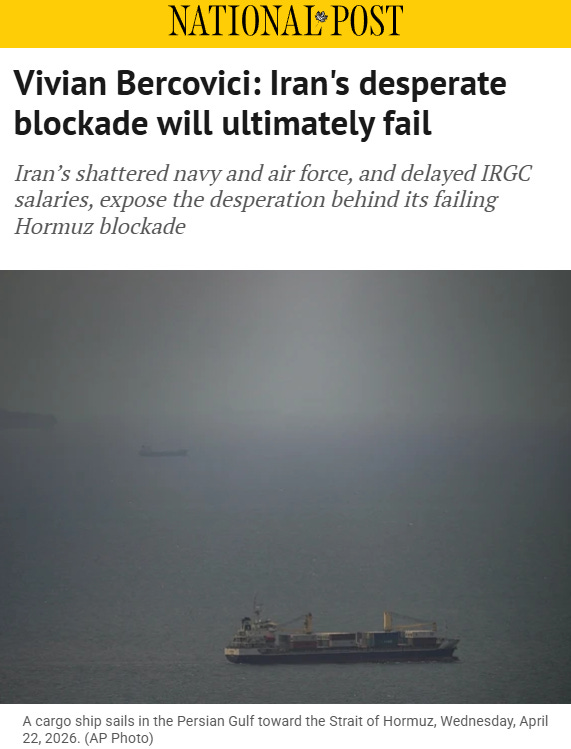
SDEROT, ISRAEL — On Wednesday, the two-week ceasefire between the United States and Iran ended. Late Tuesday night in Washington D.C., President Donald Trump announced that the truce would be extended indefinitely.
Shortly after the ceasefire was announced, Vice-President JD Vance met with senior Iranian officials in Islamabad in a 21-hour marathon negotiation. The U.S. red lines were clear: access to the Strait of Hormuz must be opened to all maritime traffic and Iran must abandon its ambition to develop nuclear weapons.
Both demands were rejected outright by Iran, which has illegally claimed (but not always asserted) sovereignty over Hormuz for decades.
This impasse over a 165-km-long narrow waterway linking the Persian Gulf to the open sea is choking maritime commerce and the global supply of oil and natural gas, 20 per cent of which is carried through the Strait.
Bordered on its northern shore by Iran, the southern edge of the Strait abuts numerous Gulf and Middle Eastern states: Oman, Saudi Arabia, Qatar, Kuwait, Bahrain, the UAE and Iraq. For all but Oman and Saudi Arabia, the Strait of Hormuz provides the only access they have to the open sea. It is a critical lifeline for global maritime commerce.
And on Thursday, at the end of a lovely day in Tel Aviv, I popped into the i24 studio at the Jaffa Port to talk about - well - we covered a lot of ground. Iran. Lebanon. Hezballah. Pakistan. And then some. Clip is below.
I was feeling bold. Hence the VERY RED shirt.

A Special Art Opening
In keeping with our weekly habit, I am closing this dispatch with something nice and light(er).
On Independence Day, my daughter who lives in central Israel was visiting me, and we skipped the bar-b-q’s and nature outings to show up for her friend and work colleague, Gali Lutski, who was opening an exhibition of her work at a lovely space in Old Be’er Sheva.
The Trumpeldor Gallery is supported by Ben Gurion University, and is a gem.
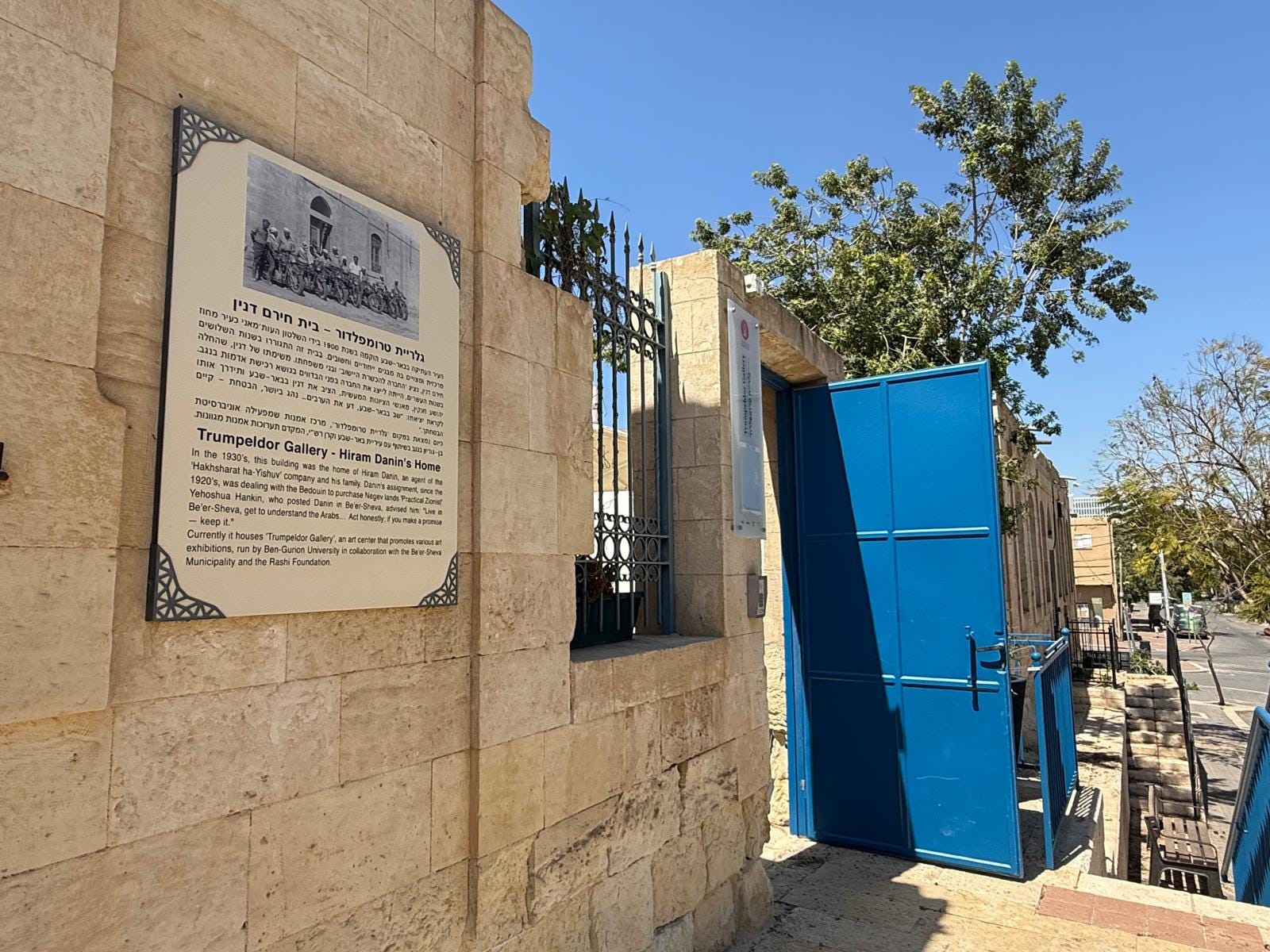
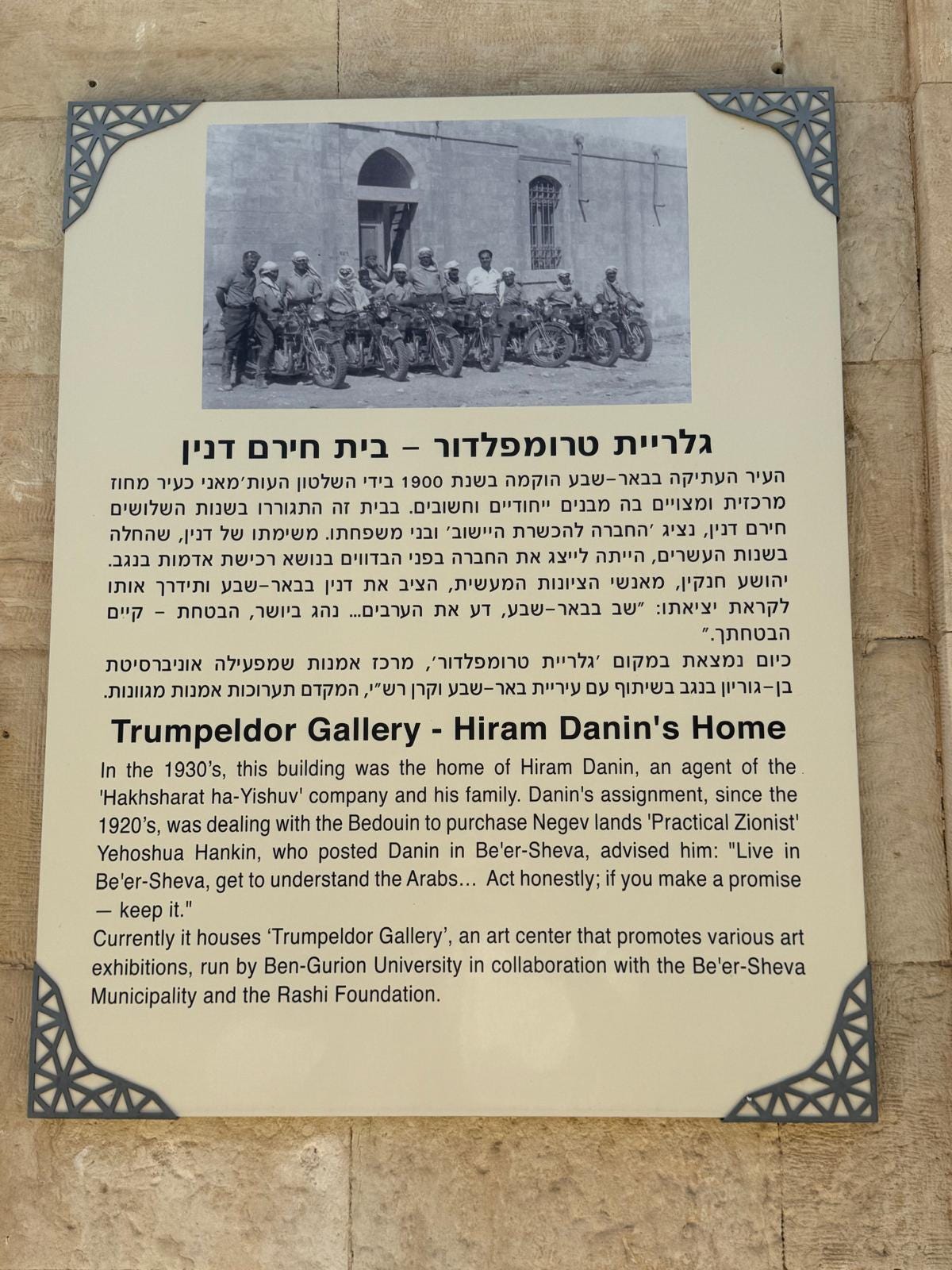
Gali’s work is amazing. Here, she is pictured (eight months pregnant with her second child) with the curator of the show, Ariela Shimshon.
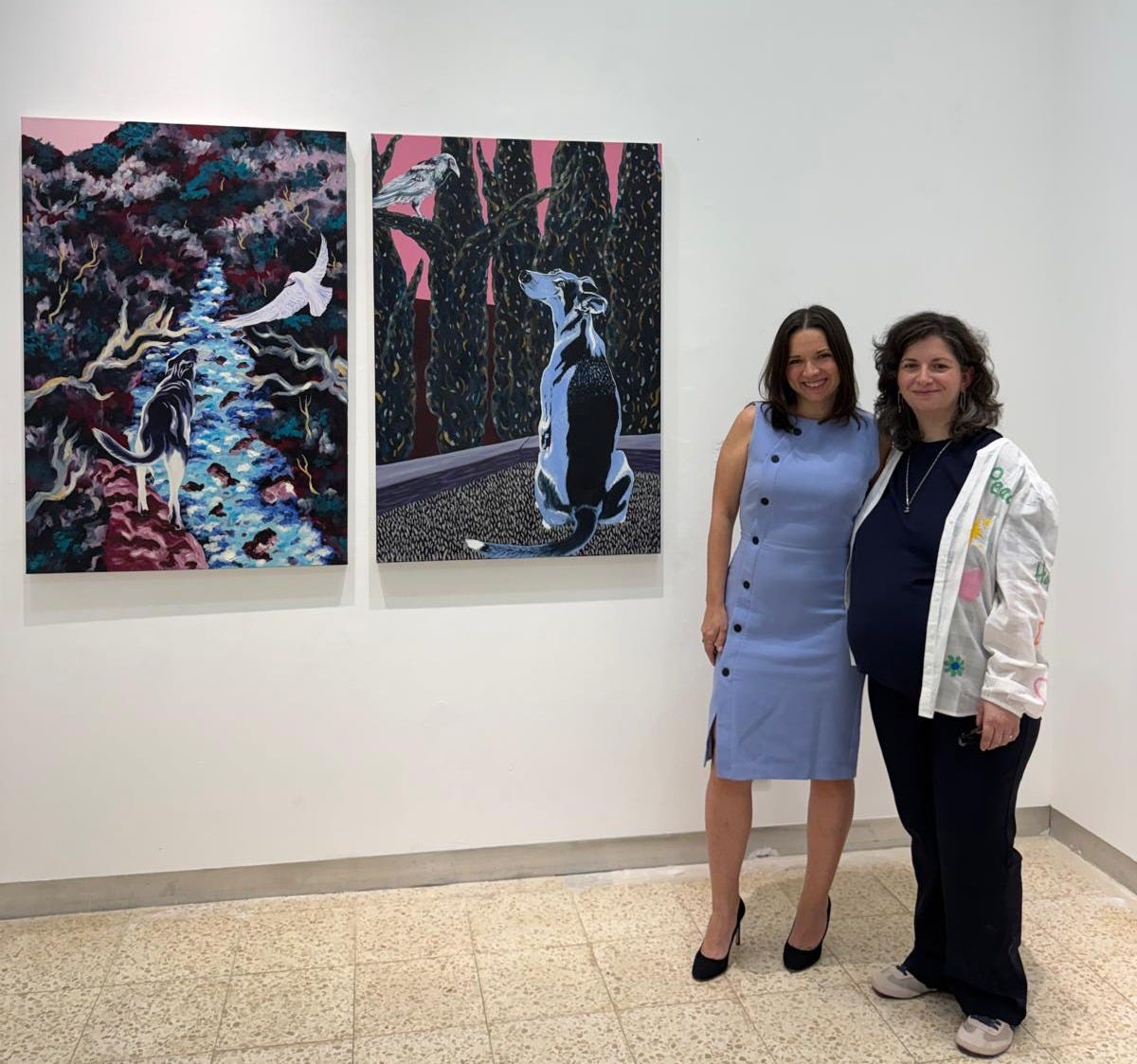
Gali moved to Israel with her parents from the Former Soviet Union at age 11. She holds a BSc. in Biology from the Hebrew University of Jerusalem, and did post-graduate work in art.
Her day job is at the Tel Aviv Museum of Art, and as with all motivated creators, she finds time to paint. Gali’s five-year-old daughter was dressed like a fairy princess in a tulle skirt and all the appropriate sparkly accessories, and she was very proud of her mom.
I thought I’d share with you a few of Gali’s works that I was particularly drawn to.
Under the Bridge is the exhibition title, taken from the painting, below. Gali explained to me that it was meant to capture many aspects of our complicated lives in Israel…..one being that we often find ourselves seeking shelter from incoming missiles and rockets……under bridges. But they are actually not safe places when we are under attack. Many searching messages are written on the grimy walls of the bridge, contrasting with the bright color just outside and seeping into the tunnel as well.
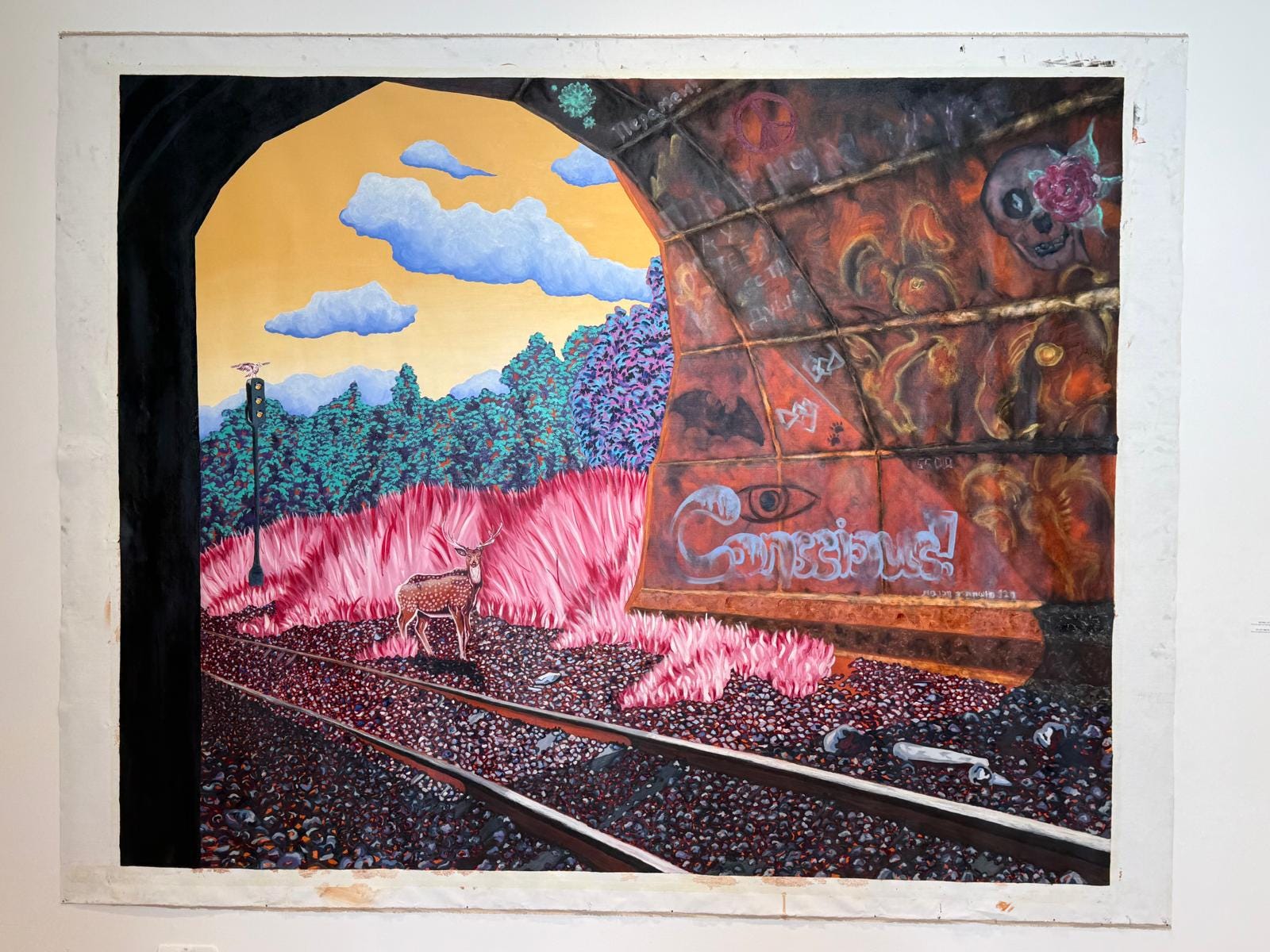
“Veteran Guardian”
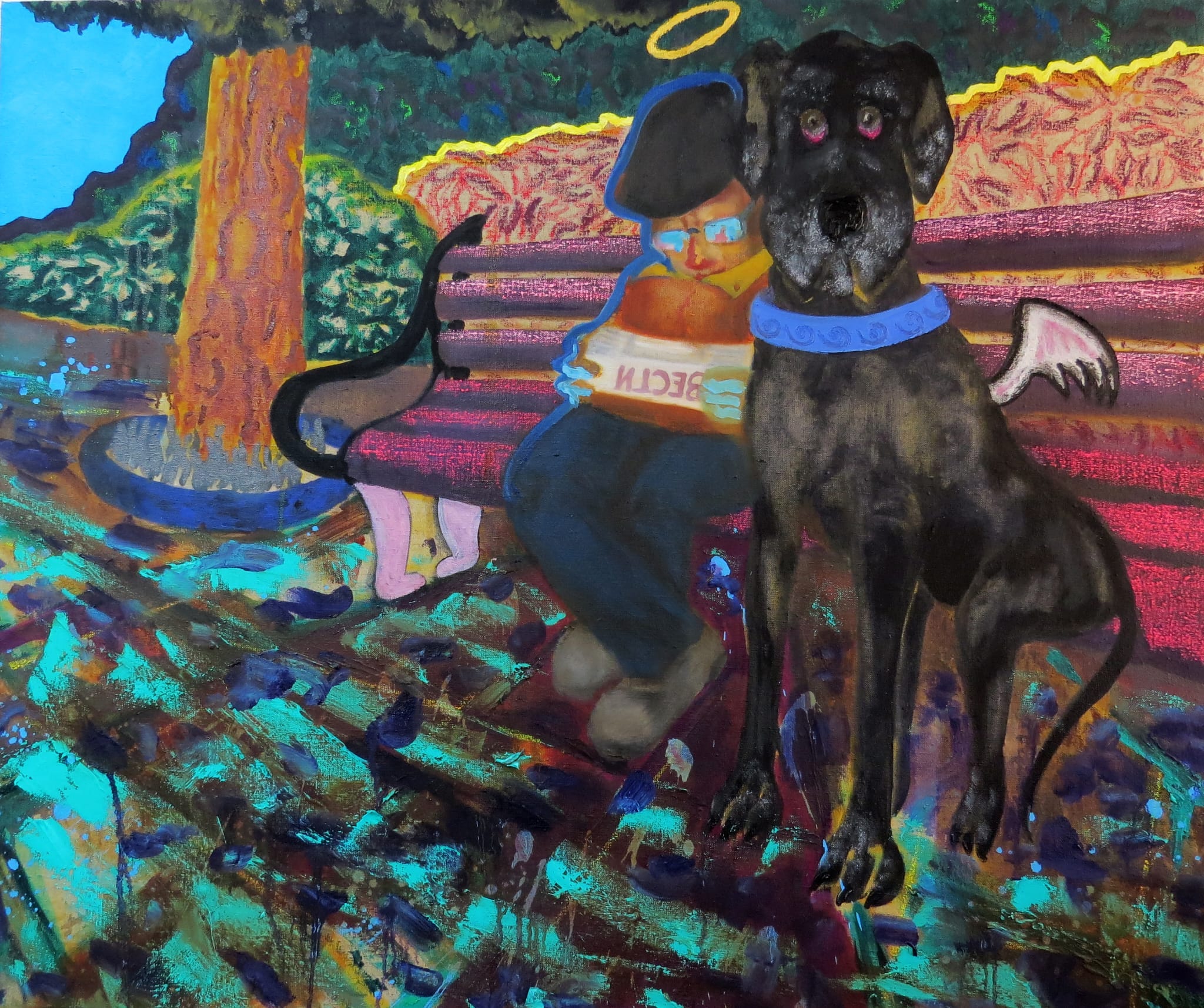
The painting below was done from memory. Growing up in the Tel Aviv suburb of Bat Yam, where many Soviet immigrants lived, Gali walked by this older man with his canine companion. Every day, for years, they sat on the bench, watching the world go by. There is a copy of the Russian newspaper Izvestiya on his chest, his head falling into it. Gali said that he seemed to be snoozing much of the time. He also had the look of a WWII veteran, she said. Hence, the name. She could not forget this image and years later put it to canvas.
“Gandir”
This fanciful painting drew me in and did not let me go. I love everything about it…..and if I had a wall that was big enough I’d buy it. It was based on a scene she had visited in Norway. I can’t find “Gandir” on Google…..so I’m going to assume it’s a fanciful name to suit the image.
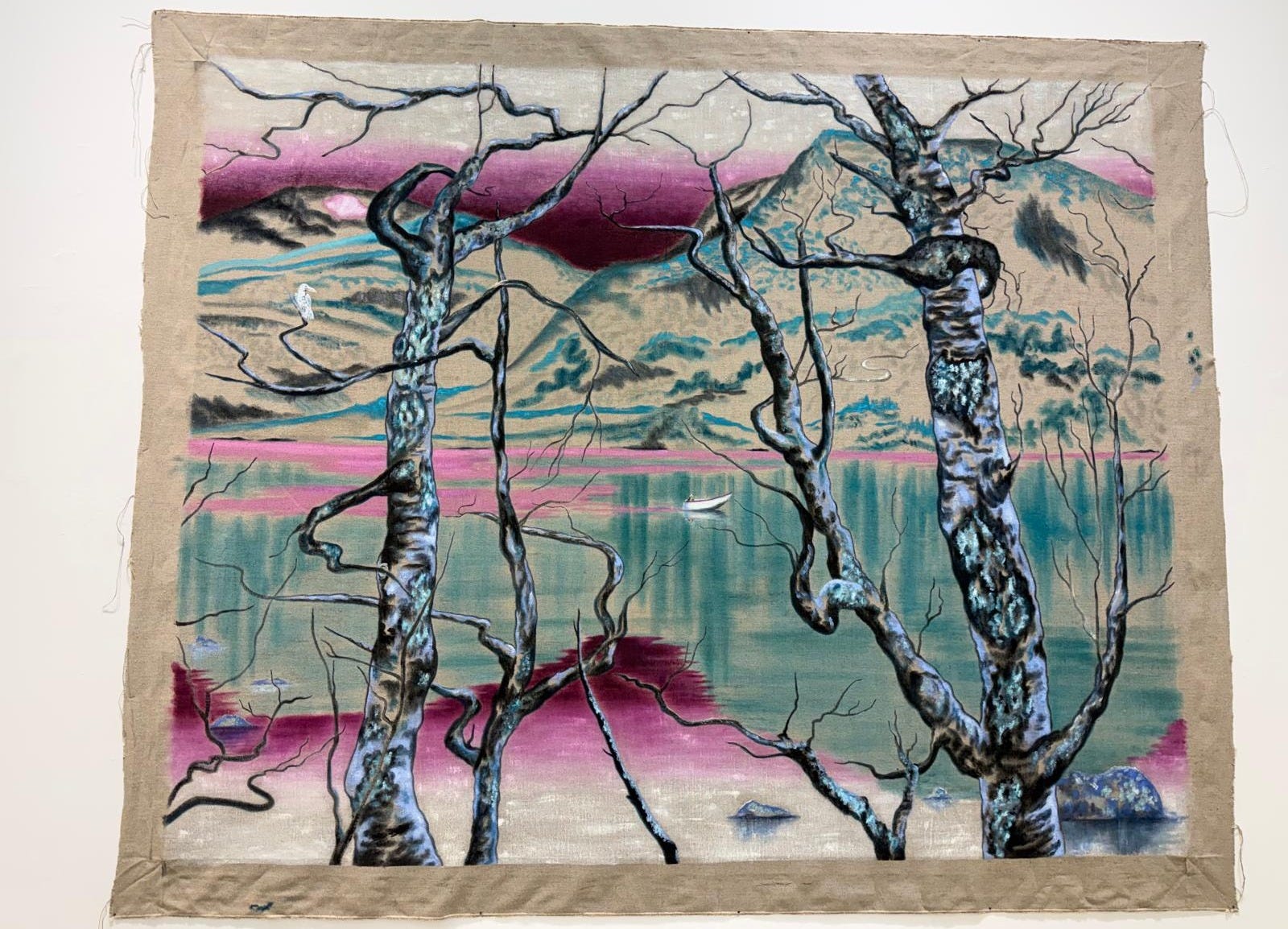
You can see more of Gali’s work on her website and Instagram.
And that, dear readers, is a wrap.
Have a safe and fun week.
Show your support for STLV at buymeacoffee.com/stateoftelaviv