

Weekly Wrap: Lebanon. Hormuz. Electric Cars.
And some housekeeping matters.


Important Subscription News:
Many of our loyal subscribers have chosen to support our work with contributions made to “Buy me a coffee “instead of purchasing a subscription on the Substack site. In the coming days, we will be making much of our content available in full to premium subscribers only. If you have contributed to “Buy me a Coffee”…..please keep an eye on your email inbox in the coming days. We will send you a note with a link to activate a complimentary subscription for a period of time commensurate with your support.
This ensures that you can continue enjoying our work without interruption. You’ll need to set up a free Substack account to activate it. The email walks you through it.
If you don’t see the email by Tuesday, latest, please check your spam folder. If it’s not there, send me a note at vivian@stateoftelaviv.com.
Of course, we will continue to make some content available to everyone, but as an independent media outlet, we rely on our readers and listeners to help keep the lights on. Thanks to all for being here. Now…..to the main event….
The Weekly Wrap:
Lebanon
One of the most overlooked minor miracles went down this week, with the Lebanese PM and President digging in on getting Hezballah out of their country. For good.
They have stated repeatedly and in very direct terms – “no more”. We want to take Lebanon back. We are beyond fed up with being used as a stomping ground for Iran’s proxy fanatics.
In the mid 20th century, Lebanon was truly the jewel of the middle east. Beirut? It was nicknamed “Paris of the middle east”. The country’s population was majority Christian with a mix of Sunni Muslims and others. The small Jewish community was concentrated in Beirut and numbered somewhere between 2,000 and 4,000 in 1975. Almost all remaining Jews left Lebanon at the outset of the civil war. At its peak - in 1948, approximately 20,000 Jews lived in Lebanon, always concentrated in Beirut.
To overly simplify, the Lebanese Civil War – which officially began in 1975 – marked the beginning of what has been 51 years of pretty much unbroken conflict. After Yasir Arafat and his PLO terrorist force were expelled from the country in 1982, Iran began eyeing the vacuum. Hezballah – the Shi’ite militia beholden to Iran for financial and all manner of support – was founded by Hassan Nasrallah and two other clerics in 1982. The movement was powerful and controlled large areas of Beirut – particularly in the south – as well as much of southern Lebanon. Eventually – Nasrallah came to be the leader of Hezballah. He was killed on September 27, 2024, in a targeted assassination by the Israeli Air Force while meeting his top advisers in Beirut.
Over more than forty years, Hezbollah developed into a fearsome military force believed to have an arsenal of hundreds of thousands of missiles and other weapons, intended to destroy Israel. The group was well-financed, disciplined and trained. They adhered to a Shia fundamentalist ideology: Muslim supremacy; anti-western; anti-Zionist.
A variation on the October 7 attack had long been planned by Hezballah’s elite Radwan fighting force. For many years, Hezballah has been boring tunnels through the hard rocky mountains in southern Lebanon with the intention to launch a surprise attack on Israeli civilians. This short video (produced by the IDF and edited by Reuters) gives you an idea as to what Hezballah has accomplished and planned over decades:
When Hezballah did not attack Israel’s northern front on October 7, Hamas leader Yahya Sinwar was deeply disappointed. Had Hezballah done so, history may have unfolded much more catastrophically for Israel.
Two and a half years on, President Trump has been working tirelessly to get Israel and Lebanon to expand upon the wobbly peace treaty that was negotiated between them by President Biden’s special envoy for the issue, Amos Hochstein. Most importantly, the Lebanese people have had enough of Hezballah and Iranian destruction of their country. Lebanese PM Nawaf Salam has stated repeatedly and unequivocally that Hezballah must be disarmed and expelled from the country.
PM Netanyahu and Lebanese PM Salam have been invited to meet next week with President Trump at the White House. Hopefully, that will go ahead.
Bottom line? Lebanon is fed up. And Israel cannot continue without neutralizing the Hezballah military threat that has made life in the northern part of the country impossible.

Jonathan Conricus and the Strait of Hormuz
It was great to catch up with State of Tel Aviv and Beyond friend and regular guest, Lt. Col. (Res.) Jonathan Conricus, to hear his take on the ceasefire/not ceasefire between the U.S. and Iran. As he makes clear in our podcast discussion from last week, the Iranian regime seems not to have fully understood that negotiating with Trump is unlike any of his predecessors. Iran has become accustomed to western leadership that tends to pander and appease. Not Trump.
Here’s the podcast episode in case you missed it.
A source of mine who has excellent access to information regarding the Iranian regime said that when the Iranian negotiating team returned empty-handed from Islamabad, President Pezeshkian flipped out. He reminded his negotiators that within days the regime would run out of cash – already in frighteningly short supply – and IRGC and Basij officials would no longer be paid. That would be the death knell for the regime.
Speaking to this cash squeeze in Iran during a conversation we had last Thursday, retired US Admiral Michael Montgomery said: “One thing about thug autocracies, they need money. People don't sign up for that quality of life unless you're paying them.” In other words - if the cash flow dries up - the IRGC and Basij enforcers may lose their zest for doing the dirty work of a brutal dictatorship.
The full podcast interview with Admiral Montgomery is coming in the next day or two.

More Hormuz
Saturday morning in Israel and it is difficult to ascertain what is actually happening in the Strait of Hormuz. Iran says that they have opened up the Strait to maritime traffic, unrestricted. The United States says it is maintaining its blockade.
On Friday, the US military released this video clip on social media, showing a US naval officer interacting with an Iranian vessel requesting passage through the Strait of Hormuz into open water. As you will hear, the American officer denies passage and directs the Iranian vessel to return to the port from which it departed. The Iranian captain confirms that he understood the message and is returning.
As I was catching up on events this. morning, I saw that President Trump stated that the negotiations are going well. Iran denies this.
I mean, it’s a certifiable gong show at this point. President Trump has insisted in recent days that Iran has agreed to hand over all enriched nuclear material to America. Iran denies this. If I had to bet I’d say that the chances of Iran surrendering its nuclear advantage to be zero. Everyone has a price, yes, but for Iran it is the survival of the regime. And for that to happen, the salaries of the IRGC and Basij must be paid. And for that to happen, it seems, Iran needs an immediate and significant infusion of currency so that it is able to pay its enforcers.
There has clearly been a lot of heated discussion in recent days.
On Friday, President Trump explained his hoarse voice as being the result of an hours-long yelling match with the Iranians the day before.
In the few hours since I wrote the paragraphs above, I have been to my local pool for a fabulous workout. Upon leaving, I had received a flurry of notices from various news sites:
“20 Omani tankers refused passage through Strait of Hormuz.”
“Strait of Hormuz now closed in response to ongoing US naval blockade.”
“IRGC fires on passing ships.”
Over the course of the day things became very heated.
After having been given permission by Iran to pass through the Strait of Hormuz, an Indian captain spoke with an Iranian official, panicked because his ship was being shot at by - Iran. “Sepah navy” is a reference to the Iranian navy. Have a listen:
By attacking a merchant vessel the IRGC has very directly challenged the United States.
A theocratic, absolutist regime like Iran is constitutionally (in the biological sense) incapable of compromise or negotiation. Pretending otherwise will just prolong the agony and conflict.
President Trump was reported to have been in the Situation Room a few hours ago. Iran’s actions are leaving the Commander-in-Chief with little choice. If he does not respond powerfully then Iran will continue with its illegal conduct - both firing on merchant ships and managing an extortion racket allowing certain ships to pass through.
Ok - it’s midnight in Israel, meaning 5 p.m. EST. I just saw this notice online:
Reuters is reporting:
Iran’s IRGC Navy broadcast over maritime radio frequencies today:
“Iran declares the Strait of Hormuz completely closed again. No vessel of any type or nationality is allowed to pass through the Strait of Hormuz.”
The message cited “the failure of the U.S. government to fulfil its commitment in the negotiation.”
I’d peg the chances of a resumption of war in the very near future to be very high. There seems to be a power struggle ongoing in Iran. But that aside - no faction in Iran will negotiate in a pragmatic, western way. This regime is and always has been absolutist - even the so-called “moderates.”
We’ll see…..

PM Carney, Canada and the Jews
On Wednesday my latest piece was published in the U.K. Jewish Chronicle, looking at how deeply antisemitic Canada has become under Prime Minister Mark Carney,

Show your support for STLV at buymeacoffee.com/stateoftelaviv


New Car Time
Ok – as always, we finish off with something fun and light.
This week we’re doing cars.
First off – I’m a girl. One of the most important things for me is color. Style. Of course, I care about functionality, but the details bore me.
I’ve had my car for 12 years. Huge point of pride. Canadian girl here. We drive through ice and snow and slush and blizzards. Salt corrodes everything. We go through cars quickly.
Not so in Israel. The climate is easier, overall, on cars…..but tougher on tires. The heat from the asphalt takes a toll and the require more frequent replacement. Then again, no need to switch tires with the season (I don’t know about you but the whole “radial” all season thing never cut it in a Canadian winter.)
I bought a great car – it’s considered small in Canada and large in Israel – and it has served me well; 12 years and could go another 12. German car. But I’ve decided to go electric, and the market has exploded in recent years. In Israel, 20% of new vehicles sold are electric (as of Q4 2025 - which are the most recent statistics available). Of new EV sales in Israel 80-85% of those sold in Q1 2026 are made in China.
As in many countries, there is concern in Israel regarding the cyber safety of vehicles made in that market. The Israeli security establishment has prohibited senior ranking officers and officials from driving Chinese-manufactured vehicles out of concern that the cars may be a back-door way to facilitate intelligence gathering and operations. Just last week, in one of the car showrooms clustered in Herzliya – a city in central Israel – a salesman told me that the class of people being limited by the Israeli government and security and military establishments from purchasing Chinese-made vehicles is growing. Rapidly.
A few months ago I was certain that I’d go hybrid. I was skittish about putting all my eggs in the EV basket. I wanted certainty regarding reliability and energy supply. If we have no oil then I can go electric. If the cost of electricity spikes then I can rely on oil.
For various reasons I’ve surrendered to the EV trend here. If there is one country where it makes eminent good sense to drive an EV it’s Israel. Battery ranges fully charged are around 450 km, give or take. There is no extreme cold in this climate – which drains batteries rapidly. Charging infrastructure is well-developed. So accessibility really is not a concern. And I have a charger installed in my driveway. So – I can be fully charged every morning and drive all day long and still have power to spare. And I do like the idea of not having to fill up on gas all the time and saving a few shekels. And reducing my carbon footprint (which is minuscule, anyways). Having said that – I am well aware that the procurement of cobalt – a critical component of EV batteries – introduces a whole whack of other environmental and ethical issues.
I’m still open to being swayed – so if you have good knowledge or strong views – chime in.
I am leaning towards an EV – produced by a joint German-Chinese venture. Very smart. Maximize the branding advantage of German design and engineering and then bring in Chinese efficiency and cost of production. I sure fell for it.
It’s a big car – biggest I’ve ever driven. Family size SUV. Why? Why not. I like it. It’s spacious. I feel safe and it does have top ratings in that category. I can throw my sports equipment and dry cleaning in the trunk, and it won’t mess up the back seat. It can hold piles of luggage (I am not known for traveling lightly – even on domestic road trips).
Perhaps most importantly - this car can handle roads in the south – which can be a little rougher than in Tel Aviv. In two years living in these parts I’ve blown out three tires. In my previous decades of driving I had one flat. One. Here? Every time has been when I am in a remote area and the events have all been dramatic. Not a puncture. Not something repairable. Full on tire devastation. I even wrote about one such episode last year.
I’m told that flats are a way of life here. So, I surrender. `I want and have decided I can justify a bigger, more rugged vehicle.
Here are some photos of one of my worst tire moments.
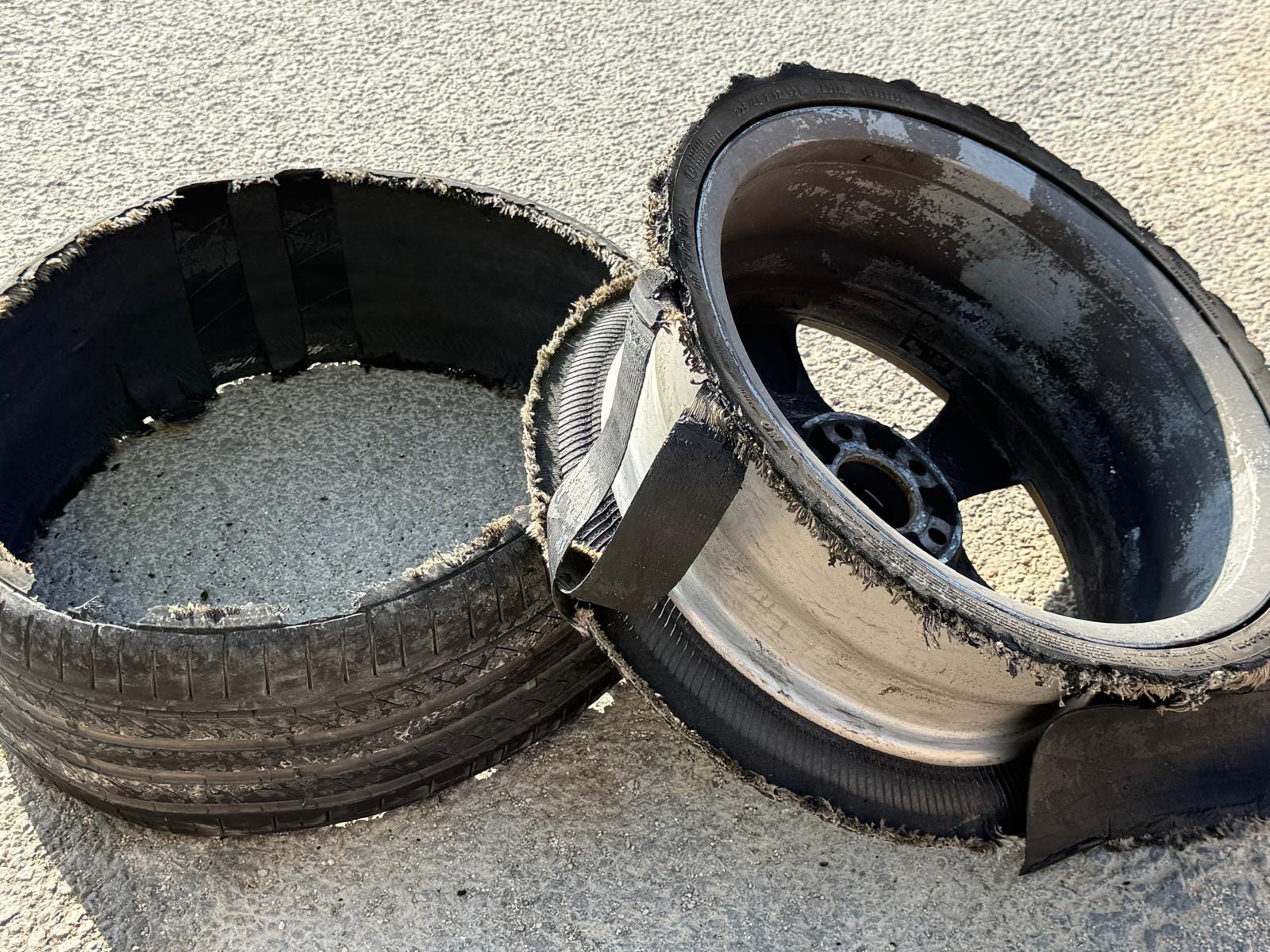
It literally just exploded. Everything was fine one moment - and then - kapow! At the side of the highway between Be’er Sheva and my kibbutz. Of course, it was a brutally hot day. No shade. And a fine young man pulled over to change the tire for me. This should be exceptional but is not. It’s an Israeli thing. People always stop to assist with roadside issues. My savior happened to be a young Arab man. Just a nice guy doing a good deed.

Back to the present.
The coup de grace?
The kids – my daughter and her partner – receive a fabulous vehicle as a gift. It has another eight years of life in it - and it is safe and far more roadworthy than the cute little jalopy they scrimped and saved to afford. I love the independence. They did not ask for help. It’s a cute little purple thing which I christened “the grape.”
Kids win. I win. China and Germany split the win. Environment? You tell me.
Have a great week.

Great article on electric cars. You seem also to know a great deal about the war in Iran.
Keep up the wonderful reporting.
H&S
Thank you Vivian for great and up to date info, doubtless due to your excellent contacts, on what’s happening in Israel.
BTW, at 68 I purchased my first new car - a Hyundai Tucson plug-in hybrid. I love it!