

Jews in Berlin. A Night at Feinberg's
Where dining on an outdoor patio becomes an act of bravery

Editor’s Note: For the last two weeks I’ve been flitting around; London, Strasbourg, Berlin. Tomorrow, Tuesday, I fly back to Israel. This trip was much-needed and long-planned - more on that in the London-Strasbourg dispatch, which will drop in the next day or two. It has been fun. And not. The Jewish and Israel thing. It has been helpful to be physically removed from the pressure cooker for a short spell, but “it” follows you. Everywhere. Always. A brief peek into random encounters with Jews and others in Europe. 2026.
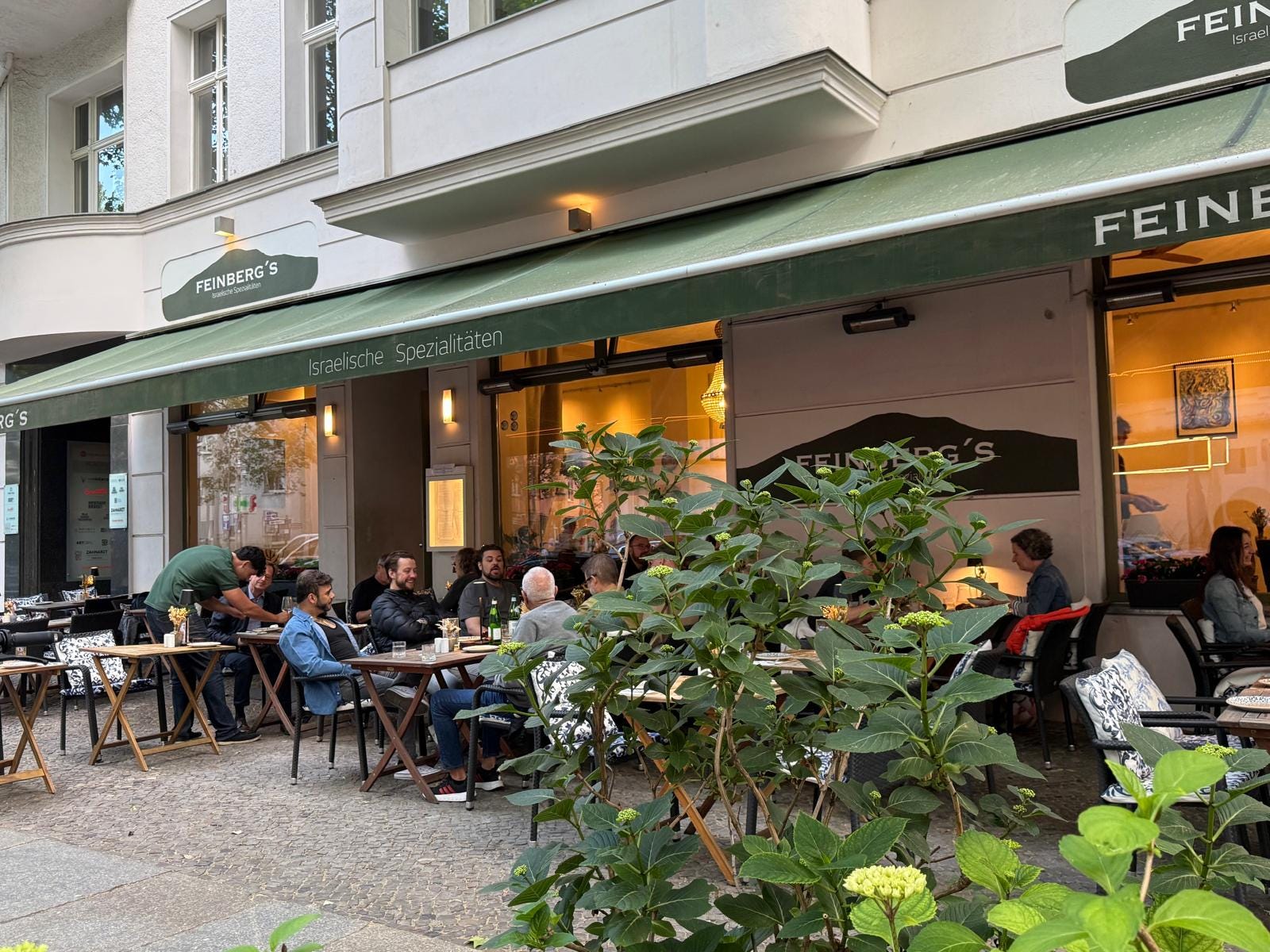
Sunday, at about 9:45 pm, local time, all our phones lit up. We were four Jews dining on a perfect late spring evening in Berlin, on the patio at Feinberg’s Restaurant, in an upscale neighborhood with a large gay demographic. Feinberg’s specializes in Israeli food. Kosher style. It’s a charming little bistro with tastefully upholstered cushions on the seats. Proper napkins and cutlery. Upscale Israeli.
In the midst of our meal Iran attacked Israel.
We each went off into our separate digital zones, communicating with friends and family. My daughter’s partner had already been called up to reserve duty. Again.
The four of us had been in the throes of a robust but (for me) somewhat tedious discussion about the ultra-orthodox in Israel and their chronic shirking of military service. Two of my dinner companions were born in the FSU; one in Kharkiv, Ukraine, the other in Riga, Latvia. They arrived in Germany along with many Jews who escaped while they could and are among the 100,000 plus who remained and made their homes in this country.
Artur, from Kharkiv, romanticizes the shtetel mentality and life, seeing it as a sign of survival and determination. He does not even want to hear about the haredi abuse of state largesse. Marina, from Riga, is less doctrinaire. She is also realistic. Then again, she has a sister living in Israel with children who are serving presently. The reality of living in a state of constant war is something she understands as an immediate threat. She also sees the perversion of piety in modern Israel as the power grab it is and not some dewy-eyed rendition of Tevye (the protagonist in the classic Yiddish story - Fiddler on the Roof – (written by famed Yiddishist Shalom Aleichem, who titled the story Tevye and his Daughters). A classic among modern Jews, Fiddler on the Roof chronicles the physical travails and spiritual rewards of an orthodox man – Tevye – in an old Russian shtetl (ghetto). It makes a great musical show but it ain’t real life.
The third dinner companion is an Israeli-German lad who has just completed his military service and decamped to experience life elsewhere. He has extended family here and feels an attachment to the place. He also needs to get out of Israel and breathe, as do all newly released soldiers. He uses a different name in Germany. To blend in. One cannot be openly Jewish in Berlin.
Just this simple act, sitting on the patio of a Jewish restaurant, is daring.
I arrived earlier than my friends and spoke with Yorai Feinberg, the man behind this eponymous eatery. He recommended the porn star martini. I obliged. And we had a short chat.
Originally from Jerusalem, Feinberg left Israel as a teen to pursue his love of ballet and dance. He spent years in London and other European cities before quite randomly settling in Berlin in 2012. He opened the restaurant one year later. It quickly became a target for Muslim hostility. Long before October 7.
Quite unplanned, I recorded a short interview with Feinberg as we waited for the others to arrive. I had thought I’d cut a few clips but it’s a super interesting ten-minute conversation. The link is just below. We cover a lot of ground, focusing on his experience since opening the restaurant. Since 2013, Yorai, his employees, his patrons, have been harassed unceasingly by Arabs and Muslims. Customers sitting outside are bothered. Seat cushions were torn up just the night before I was there. Uber drivers refuse to service customers or deliver food. You get the idea.
I spoke with one of his wait staff when I arrived. He acknowledged the challenges but said, “we are brothers.” He is of Armenian descent. They get it, the Armenians.
As Yorai and I spoke, a marked police car pulled up and idled in front for quite some time. Until very recently, Feinberg told me, Berlin police surveilled the restaurant and his personal residence 24/7. He tells me about a known plot involving Iranian agents in which he and other Jewish individuals in Berlin were targeted.
I’ll say this for Berlin police: I have now visited the city several times since October 7. They do not mess around and have zero tolerance for Islamist hatred. Like, zero.
Here’s my conversation with Yorai Feinberg. It was spontaneous and low tech. So you will hear ambient street noise. Audio only:
The dinner that followed was sublime. I’m not much of a meat eater but I devoured the shared platters that were served. I also felt very vulnerable, to be honest. You sit there, out in the open, and you are a sitting duck. Dining al fresco becomes an inadvertent declaration of resistance.
Yorai is leaving the next morning for a short trip to the south of France, so we continue on without him: me, Marina, Artur and our nameless German-Israeli IDF reservist. We speak about the Islamization of Europe. Berlin. Each person at the table is a strong supporter of Israel, albeit with very divergent political views. Artur is hard right. He reveres Netanyahu as a sort of demi-god, beyond rebuke. Whatever Bibi does is brilliant, even when it’s not. And there is no room for discussion.
The common ground is the shared view of the Islamization of Europe. We talk about that. A lot. About how Germany is afraid of itself. Its past. And is just allowing this to happen.
Like Marina, who has a more nuanced understanding of, well, everything, Artur sees the Islamization of Germany as an inevitability. But none of them have plans to relocate. With Jews everywhere, it seems, there is this reluctant acknowledgement that society is moving in the wrong direction, but each person seems to believe that they will somehow manage to sidestep calamity.
Marina recently posted a long statement on social media in German. It went viral in Germany and gives you a peek into her daily reality.
Here is the English translation:
Nowadays, at every public appearance, I am asked whether I wouldn’t prefer to remain anonymous.
Not because I am a particularly prominent figure.
Nor because I bear a proud Jewish surname.
(Although—by now, that alone would be enough.)
Rather, it is because people now research us in order to track down our addresses.
To do us harm.
You see, I am a mother of two children.
My eldest now attends a Jewish school.
Not because we wish to segregate ourselves.
Not because we seek to create a parallel society.
But because antisemitic incidents occur time and again in public schools.
My younger child also bears a proud Jewish name.
That is why, at the playground, I only call him by his nickname.
Nanyu.
Because now, right here in our park, people are scrawling their hateful slogans onto the little wooden climbing tower.
There’s plenty of space there, you see.
Plenty of room to vent.
“Fuck Israhell.”
“Death to the IDF.”
“From the river to the sea.”
“Globalize Intifada.”
“What does this say, Mama? Why do you look so sad?”
Oh, sweetie—they are wishing death upon your cultural homeland, upon your aunt and your cousins in Israel. They want there to be no Jews left in Israel. They are calling upon the world to unite against us Jews.
Of course, I didn’t say that out loud.
We don’t really speak out loud anymore, anyway.
Once—sometime after October 7th—when we were discussing the conflict in the Middle East out on our balcony, the neighbors next door hung up a banner:
“Free Gaza!!!”
I asked my husband:
“Do they mean us, dear?”
He is Serbian, you see.
He replied:
“No, baby. They mean you. I can’t free Gaza.” When we moved into this apartment, my husband said:
“Of course we’ll hang up the mezuzah. No one should have to hide their identity. We’re in Berlin, babe. The city of diversity.”
Today, he says:
“We don’t want to provoke anyone, do we?”
Provoke.
A mezuzah.
A small Jewish symbol on the door.
On our street in Schöneberg alone, we counted nine Palestinian flags after October 7th.
Naturally, our mezuzah shouldn’t provoke anyone here.
After all—as you know—a man in our neighborhood did provoke a knife attack just by wearing a Star of David pendant.
A small Star of David on one’s chest, it turns out, provokes a knife attack.
Just imagine what a mezuzah on the front door might provoke.
These days, we provoke very little at all.
We no longer speak Hebrew with our children in public.
When talking on the phone, we no longer say words like: Jewish, Israel, antisemitism, synagogue, Chag Sameach, Mazal Tov, Shabbat Shalom.
Funnily enough, words like Gaza, Hamas, Hezbollah, and October 7th seem to provoke people, too.
So, we don’t say those either.
We no longer unlock our phones while riding the train.
Group chat icons, friends’ avatars, Hebrew letters, yellow ribbons—any of it could be seen as a provocation.
Standing here today is a man whose yellow ribbon—pinned to his jacket just a few days ago—provoked a knife attack on the train.
A yellow ribbon.
Worn in solidarity with hostages.
Our building is old. Things break often.
Every time a repairman comes over, I rush through the apartment, hiding the Chanukkiah, the Birkat HaBayit, and any stickers lying around that read: “Berlin Against All Antisemitism.” During Hanukkah and Passover, putting everything away becomes a particularly cumbersome task.
All so as not to provoke anyone, of course. Not to mention delivery drivers or Uber drivers.
All people who know our addresses.
The latter, suddenly, all seem to come from Palestine now.
From Haifa.
The Jewish community has long since started sending out its magazine in a plain, unmarked envelope.
So as not to provoke, of course.
A great many of us no longer attend Jewish events.
Not the synagogue.
Not concerts by Jewish musicians.
Because it is dangerous.
In schools, teachers are afraid to take a stand against antisemitism.
They do not want to provoke the parents.
For a Jewish event involving young people, organizers preferred to buy a laminator and make the badges themselves, rather than sending a list of Jewish names to an outside company.
In the Germany of 2026, a laminator counts as a security strategy.
On Friday, Jewish art spaces were opened in Kreuzberg.
No sign on the door.
After all, one wouldn’t want to provoke anyone.
In Neukölln, a non-Jewish bar went a step too far in its efforts to combat antisemitism through its educational program—you see.
Now, it is guarded around the clock by three police cars.
Posters bearing the faces of the bar’s owners were plastered all over the streets, and the provoked populace was called upon to silence them—forever.
An entire district of the capital of that very country—the one that has tattooed the words “Never Again” onto its forehead; an entire district where every single wall screams at us that we are not welcome here.
Today we stand here because, in the oh-so-cosmopolitan Prenzlauer Berg, it was made unequivocally clear to us that we Jews apparently provoke merely by the fact that we exist.
“The only good Jew is a dead Jew.”
The silent Jew.
The museum-piece Jew.
The Jew from the memorial site.
But woe betide the Jew who lives.
Woe betide the Jew who wears a Star of David.
Woe betide the Jew who hangs a mezuzah on their door.
Woe betide the Jew who defends themselves.
Then—they are provoking.
I would like to ask you today:
Which other people—which other ethnic group, which other religious community—in this country experiences such a daily reality?
I am not speaking of exceptions.
I am speaking of the daily reality of every Jewish woman and every Jewish man in the Germany of 2026.
Please spare us your empty “Never Again” platitudes, dear government.
Spare us, too, your position papers and action plans.
Start taking action. Start calling things by their proper names:
Do not speak merely of “anti-Muslim racism” or “Islamophobia.” And do not speak of “integration failures” when what you mean is Islamism.
Do not speak merely of antisemitism when what you mean is unadulterated Jew-hatred.
Not only from the Right.
But also from the Left.
And do not speak of harmless anti-Zionism when what is meant is this:
The only good Jew is the dead Jew.
The one who cannot fight back.
But we are living Jews, and we will no longer keep our heads down. That is why we stand here today, appearing under our full names. Because we will no longer live in fear.
Get used to it.
Here is the original post in German on Instagram:
We lingered and were the last to leave Feinberg’s. I walked back to my hotel with the young, newly released IDF soldier. He has family in Germany and is keen to be immersed in a different environment. At the restaurant, we all spoke a jumble of English and Hebrew and Russian. On the walk through Berlin, we dared not utter a word of Hebrew.
Neither one of us could order an uber. We are both traveling with cell phones with the Israeli country code. 972. No uber driver in Berlin will pick us up. In fact, even when I am in Toronto, I do not use uber. Same reason.
Everywhere, everyone feels deeply unsettled but also, oddly, stuck.
Where can we go?
Where is it safe?
We can’t afford it.
Maybe things will improve.
When the Soviet regime fell and the exit gates opened close to two million Jews who had been trapped for decades jumped at the opporunity to leave. More than one million made their homes in Israel. Many relocated to America and Canada. And a surprisingly large number made their new home in Germany.
Germany. Of all places.
I recall vividly the horrified reaction of North American Jews.
How could they?
The North American Jewish community is diverse, of course, but in its marrow is reactionary and judgmental.
What they could not understand was how difficult it is to transplant oneself in middle age. Learn a new language. Establish oneself professionally. Germany made all of that easy. Resettlement was carefully thought through and supported. That is not the case in North America.
I learned last night that the FSU emigres to Germany were dispersed to towns and cities all over the huge, newly reunified country that had been split into two since WWII. I was surprised to learn that in a huge city like Berlin, there are only 10,000 Jews, at most. In Dortmund, with a population of 600,000, there are 6,000 Jews. Many Jewish families were directed by the German authorities to live in towns and cities in the former East Germany, with a depressed economy and need for revitalization in every way. And so, unlike in virtually every country in the world with a sizeable Jewish population, in Germany the community is dispersed. North American Jews would never submit to such control. But these weren’t North American Jews. They had been repressed indescribably. They accepted direction and support from the German government with gratitude.
In the immediate aftermath of the collapse of communism, more than 200,000 Jews from the FSU made their homes in Germany. Many subsequently moved elsewhere.
Today, there are approximately 130,000 German Jews, 90% of them with origins in the FSU. They have integrated well, revitalized Jewish life and they appreciate the opportunities this country gave them. They are not in a rush to leave. And, as Marina so forcefully says, they should not have to.
I recently had an online exchange with another friend, well-established in Toronto but clear-eyed about the future. He came with his family from Ukraine as a young boy and has been extremely successful – as has his wife (also from the FSU).
As seems to happen regularly these days, we ended up discussing where it is safe for Jews to live. We agreed on the limited options. I commented, “and even those are temporary.”
“Everything is temporary,” he replied. “We are a transient people.”
Everything, it seems, has changed, whereas in fact, so much remains the same.
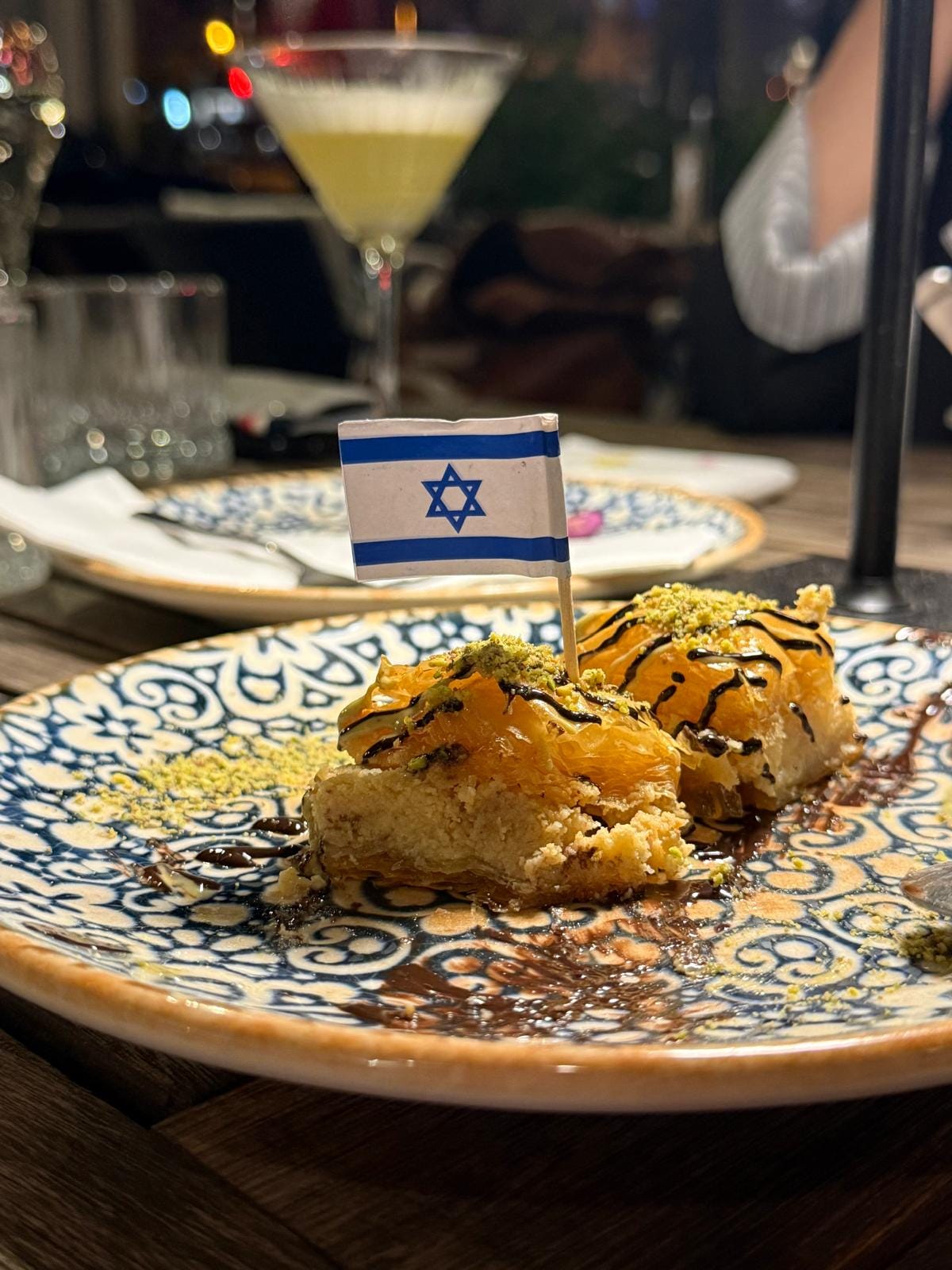
(I’m pretty sure that Yorai does not decorate desserts for all with an Israeli flag, but we appreciated the gesture.)

I am scheduled to fly back to Israel tomorrow, Tuesday, with El Al, of course. And fortunately, it seems that I will make it home in spite of Iran’s best efforts to spark further conflict.
Cheers. L’chaim. And - as my father said every Friday night: “Chaim who?”
Dad joke.
Show your support for STLV at buymeacoffee.com/stateoftelaviv

Hi Vivian,
I'm approaching 90 years of age and was beginning to believe that I would
leave a world free of overt antisemitism. Your excellent article showed me
that Jews have a long way to go in order to be left in peace.Please keep
helping us to reach that goal.
HN
Great update from Berlin, Vivian. This sentence hit me:
"With Jews everywhere, it seems, there is this reluctant acknowledgement that society is moving in the wrong direction, but each person seems to believe that they will somehow manage to sidestep calamity"
What drives the believe in avoiding the calamity all see clearly in front of their eyes? Is it the same story as 20% that left pharaoh's Egypt and 80% lacked the wherewithal to pack up and go?