


Editor’s Note: In late July, I flew from Israel to Vienna for a one-week diversion en route to my long, annual summer holiday in Canada and the U.S. I moved up my departure date out of concern that war would erupt, again, between the U.S. and Iran. Depending on the intensity of the conflict, Israelis were alerted to the likelihood that commercial air travel to and from Ben Gurion Airport may be disrupted, or suspended. Having experienced several of these episodes in the last three years, I decided to cut my losses and fly out while I could.
As it turned out, we have since learned that an attack planned to begin in late July was aborted at the last moment. And I had a week to fill in Austria; not exactly a punishment but the scorching heat wave that settled on the country the day I landed did present some challenges.
I share below some of the more interesting encounters I had.
Reminder: We will go dark during the week of August 31, unless something crazy happens. It’s the last week of summer and I plan to spend it lakeside at a cottage north of Toronto. It is also my birthday week.
Erasure
Every Sunday at 1pm, a walking tour of “Red Vienna” is led by a local historian.
In the interwar period, Europe was fraught with all manner of tension. Extreme poverty and disease were rampant. There was no social safety net. Optimism was in short supply. Monarchs and aristocrats were dethroned, dispossessed and disenfranchised.
This was also a time of bold artistic experimentation in every medium. Bauhaus was big. As were many “isms”, among them dada, surreal and constructive. The overarching principle seemed to be to deconstruct, reorder, and seek meaning and practicality in the volatility and chaos. Literature tended – like other forms of expression – to be driven to explore the lack of constraint in the subconscious. Stream of consciousness was elevated to an art form. As did visual artists, writers and dramatists strained to make sense of a devastated Europe and the momentum behind fascist and communist political movements. The oeuvre of that period tended to be bleak, ominous, and confusing, as were many aspects of life.
The Communist revolution had overtaken Russia. Following a dynastic reign of just over 300 years of Romanovs, the Tsar and his family were murdered by Bolshevik revolutionaries in a cellar. Across Europe, the great imperial powers of centuries past were diminished or overthrown. Their territories were reinvented as nation states. Any remnants of royalty were reduced to pageantry. Power was no longer the preserve of the dynasts.
The great, emergent world powers of the day – America, Great Britain, France, Japan and Italy - spent months in Paris during 1919, deciding how they would carve up the European continent and former colonial outposts.
Germany was held responsible for the horror of the Great War and the terms of its vanquishment were punishing. Humiliation is the word most often invoked. The Treaty of Versailles imposed taxes and economic burdens on Germany that ensured long-term economic servitude to the rest of continental Europe. Millions of Europeans took advantage of the instability and left their homes, not really knowing where to go but quite certain that nowhere could be worse than where they were. Today we would refer to them as migrants.
Instability often leads to radical change. And the tension between the fascists and socialists was fierce, with each camp determined to prevail and reconstitute European society.
During this period a remarkable experiment was undertaken in Vienna. A massive housing block was conceived and built to address extreme deficiencies in the lives of the underclass and society at large.
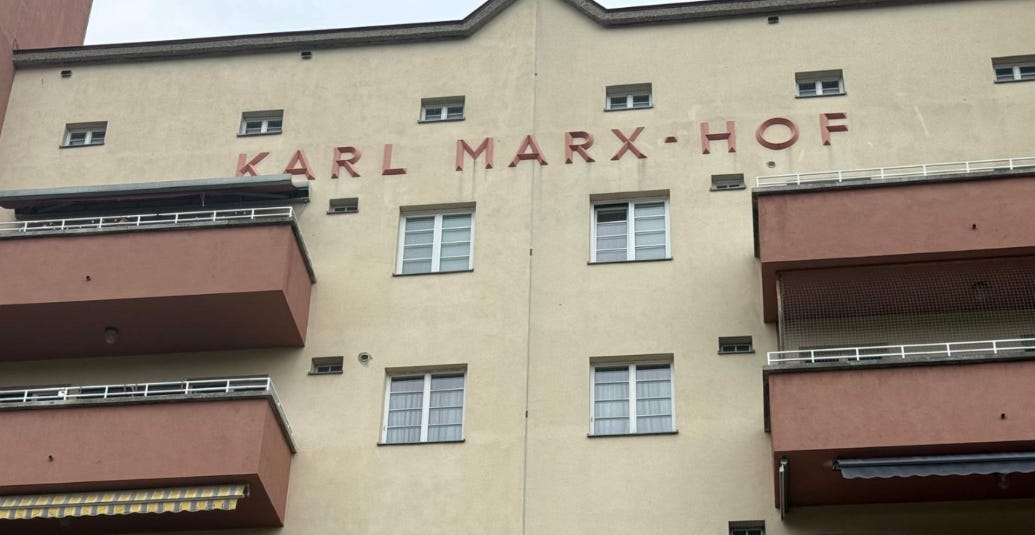
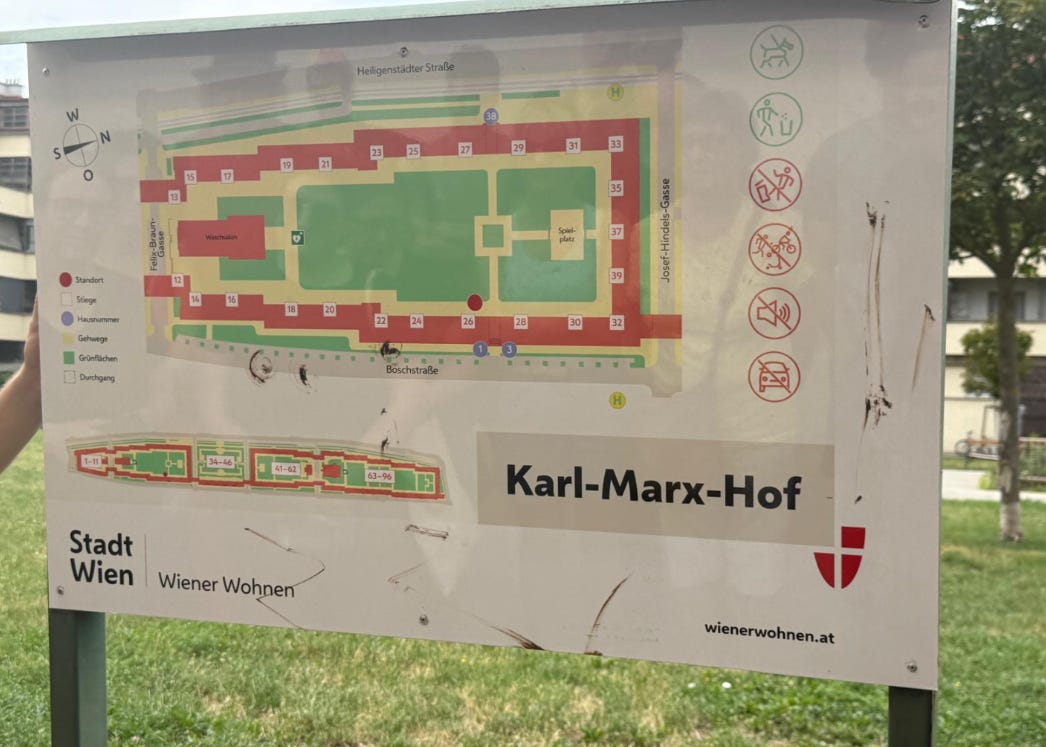
Housing tens of thousands in its early years, the structure pictured above – Karl Marx Hof – is more than one kilometer long. The community is fortress-like, a massive rectangle with an enclosed courtyard. Access to the buildings from the street is restricted by a small number of passageways. When the futurist project was completed in 1930, it was envisioned as a community to encourage social responsibility and improved living standards.
Entry into the complex from the street after 10 pm resulted in a fine being levied, unless the person was coming from work. Otherwise, no legitimate reason – other than vice – could account for returning home at such a late hour. Children were permitted to play only on the paved perimeter of the inner square. The enormous grass field was for show. In fact, it doesn’t appear to be used as a recreational space even today.
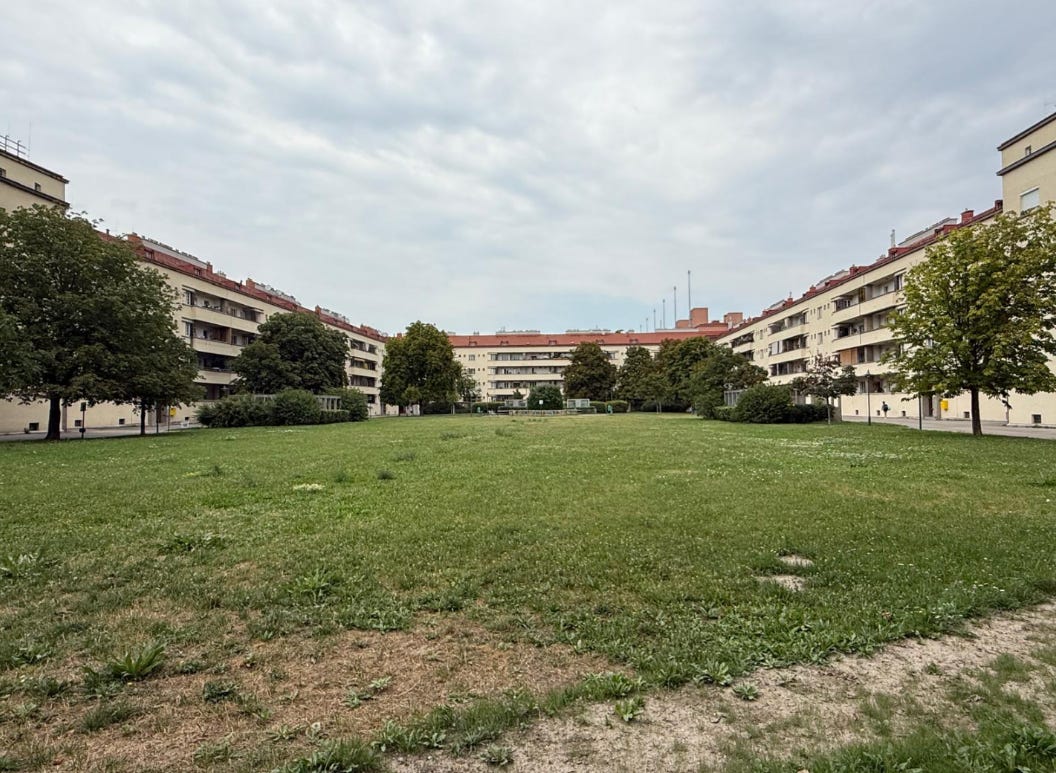
The building was subdivided into blocks. Organized squads of residents were responsible for maintaining social order; responding to domestic violence calls and neighborhood issues. Alcohol consumption was discouraged and, where there were problems – the squads stepped in.
In return, the residents were allocated a small apartment for very low rent. Communal laundry was free of charge. Bathing and other hygiene facilities were also available on a weekly basis.
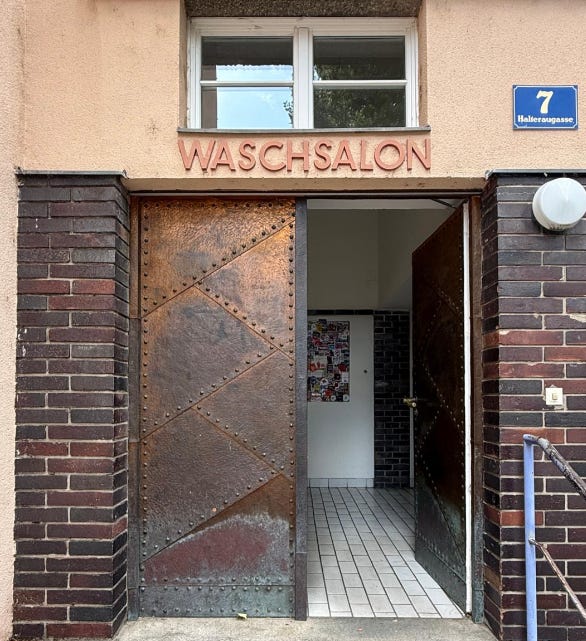
Day-care for pre-school children was offered from 8am to 6pm for a pittance – including three meals. In the first year after people moved into Karl Marx Hof, tuberculosis rates dropped by 50%. Thousands of poor Viennese moved from cramped, squalid, filthy slums to the clean, sunlit and well-ventilated apartments with access to sanitation, clean water and basic conditions for healthy living.
But Karl Marx Hof represented everything the fascists despised. Throughout much of the 1920s, they led the Austrian government. As we know today, they prevailed through 1945.
Among the men who were central to developing the concept of Karl Marx Hof was Hugo Breitner, a socialist Jewish banker. Shortly after WWI, he left his comfortable profession to develop affordable housing for the poor in Vienna. This ambitious social engineering initiative was financed by what locals called the “Breitner tax”; a surtax imposed on the wealthy to lessen the burden on the poor.
Breitner was imprisoned briefly by the fascist government in Austria in 1934. Shortly after his release he escaped to Italy and then moved on to California. Several of Breitner’s key colleagues in developing and managing Karl Marx Hof, like him, were Jewish.
That was not mentioned on the tour.
As the fascist squeeze on Austria tightened, the prominent Jewish drivers of Red Vienna fled the country. Those who made it to England, Australia, Shanghai or America survived. Many, mistakenly, believed they would be safe elsewhere in Europe.
Vienna at the turn of the previous century was very much like so many western cities in which large Jewish communities have flourished in recent decades in the west. It had been among the first European cities to emancipate Jews. The Austro-Hungarian Constitution of 1867 conferred full civil rights on all citizens. Unsurprisingly, Jews from all over Europe gravitated to this place of extraordinary freedom.
In 1850 there were approximately 10,000 Jews living in Vienna. Fifty years later that number had soared to just under 150,000, comprising about 10% of the city’s population. During the 1930s, the Jewish population peaked at 200,000, give or take, before being destroyed. The city attracted many Jews from elsewhere in eastern and central Europe during the interwar period, when mass migration was a thing.
I mean, who would not want to move to Vienna? It was a magnet, particularly for the culturally and academically inclined. Few cities in Europe at that time afforded the professional, intellectual and lifestyle freedom that was quite normal in Vienna. And as it remains today, it was a city of extraordinary beauty.
Until it changed, quite literally overnight.
By 1938, more than 60% of practicing lawyers in Vienna were Jewish. Overnight, following the German Anschluss in March 1938, their professional licenses were revoked. Similar fates befell physicians, architects, engineers. They were stripped of all civil rights, citizenship and the ability to support their families. Teachers, academics and public servants were fired.
The Jew was a pariah. By law.
Within weeks of the Anschluss just under 80% of the medical faculty in Vienna was dismissed. Virtually all were Jews. A small number of gentiles were deemed to be political enemies. The University of Vienna Medical School – which was then considered to be among the very finest in the world - has never recovered its former glory. Today, it languishes at around 80th – to 200th-ish, depending on the organization doing the ranking.
Throughout the “Red Vienna” walking tour, complemented by a visit at the end to a small museum, there was no mention of Viennese Jews. Not as social activists. No mention of how they were increasingly shunned by the broader society in the 20’s, nor of how they were beaten and humiliated by fascists in those years. Their contribution to Viennese culture in every respect has been subsumed, at best; erased, at worst. They just…..disappeared.
Gloss
From Salzburg, a picturesque Austrian city, it is a half hour drive to Eagle’s Nest, Adolf Hitler’s mountaintop lair just inside the German border.
To celebrate the Fuhrer’s 50th birthday on April 20, 1939, Hitler’s personal secretary, Martin Bormann, planned a majestic surprise; the construction of a rustic lodge set on the peak of Kehlstein mountain, overlooking the Berchtesgaden town and valley. The ambitious project resulted in farming families in the surrounding valleys being forcibly displaced from homesteads that had been passed down for centuries.
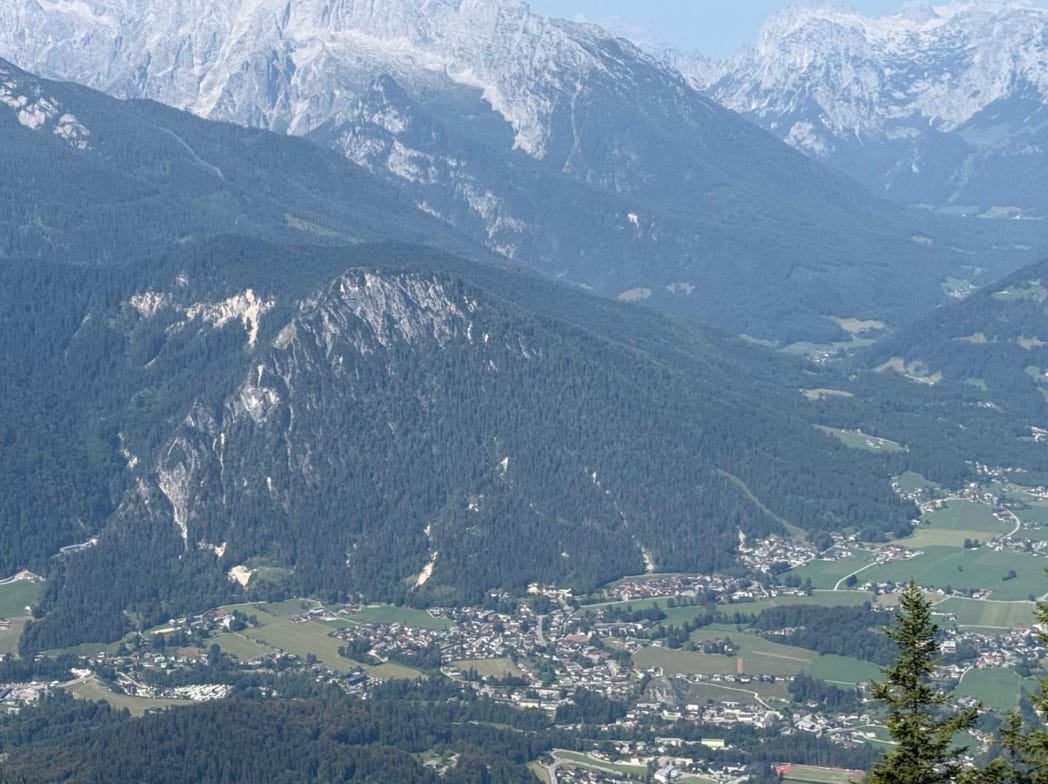
View from the Eagle’s Nest to the valley below
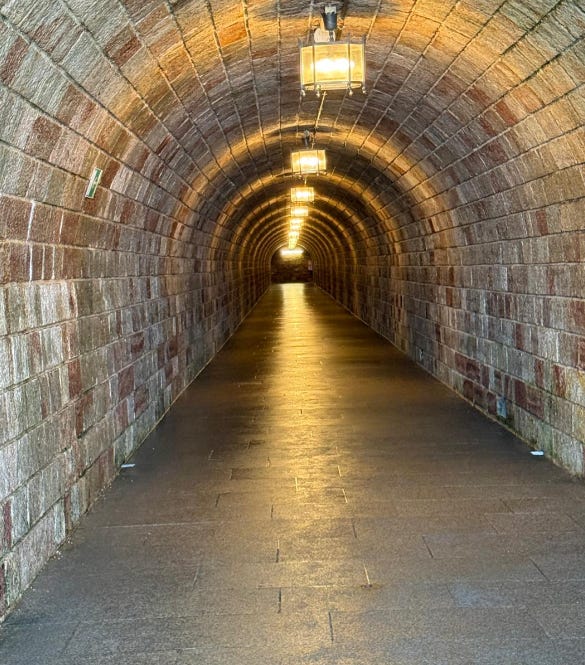
Workers carved treacherous roads into the unyielding rock face at a frenzied pace. Many died during construction. Nevertheless, the Fuhrer was unimpressed with Bormann’s gesture. Hitler was fearful of heights. A dark, dank tunnel several hundred feet long led to an elevator which was the only way up. Or down. Apparently, Herr Hitler was also claustrophobic.
He preferred to hang out in a house lower down the mountain known as the Berghof. It was there that he spent the evening of February 12, 1938, with Austrian Chancellor Kurt von Schuschnigg. Along with his inner circle, Hitler bullied and humiliated von Schuschnigg – who was determined to maintain Austria’s independence from Nazi Germany. By the end of the evening, von Schuschnigg was forced to accept the terms dictated by the Fuhrer for the Anschluss. Exactly one month later – March 12, 1938 – German troops conquered Austria.
Not a single bullet was fired. Austrian troops had been ordered to stand down but it is remarkable there were no pockets of resistance to challenge the “annexation” of Austria. Quite the opposite, in fact. Nazi troops were festooned with flowers. Frenzied, ecstatic crowds cheered their arrival.
Schuschnigg was imprisoned in a concentration camp until the end of the war.
Austria is regarded by many as having been an enthusiastic supporter of Hitler’s Nazi vision for Europe and beyond. The national school curriculum is very “light touch” when it comes to that period of history, tending to gloss over the nasty bits. All Austrian students will likely visit Mauthausen concentration camp at some point, but the examination of the role of the country in the horrors committed there – and elsewhere – is thin, at best. The official historical rendering defaults to promoting a narrative maintaining that the Austrians had no choice but to accede to the brutal Nazis.
“We were occupied,” they say.
“You welcomed the Nazis,” many respond, “and did not resist in any meaningful way.”
Note: While wandering around the Eagle’s Nest, I suddenly recalled having read an extraordinary book more than a few years ago by Eric Vuillard, titled The Order of the Day. The novel is a rendering of the evening at the Berghof hosted by Hitler, at the end of which von Schuschnigg had agreed to the terms of the Nazi takeover of the country he led. The book won the French Prix Goncourt in 2017, the equivalent honor and recognition as the U.K. Booker Prize. Highly recommended.
On my final afternoon in Austria I met an acquaintance in a storied Vienna Café. He had relocated recently last with his family. From Jerusalem. Having lived in Israel now for almost 13 years – I understand that decision. I understand why record numbers of Israelis are leaving the country to begin again, abroad.
I am often asked – by diaspora Jews who question the wisdom of Israelis decamping – “Do they know about antisemitism?”
Of course they do. Somewhat.
I often respond by asking - “Do you intend to move to Israel at any time?”
“Do you understand what it is like to live in a country that has been at war for three years and becomes more extreme and less recognizable by the minute?”
We all know the answers to both questions.
My Vienna friend tells that his family has adjusted quite nicely. I understand his reasons for having left what Israel has become. In fact, the statistics for Israeli emigres has been on a steep and worrisome trajectory for three years now. Too many educated, liberal Israelis are looking at the present and anticipating a future that they do not want to inhabit.
We discuss the “gloss factor”, and how Austrians have historically been disinclined to ponder their past.
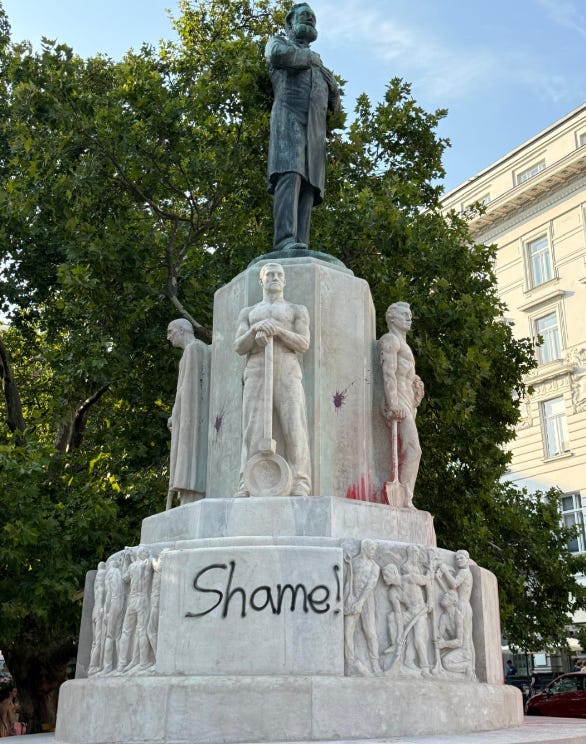
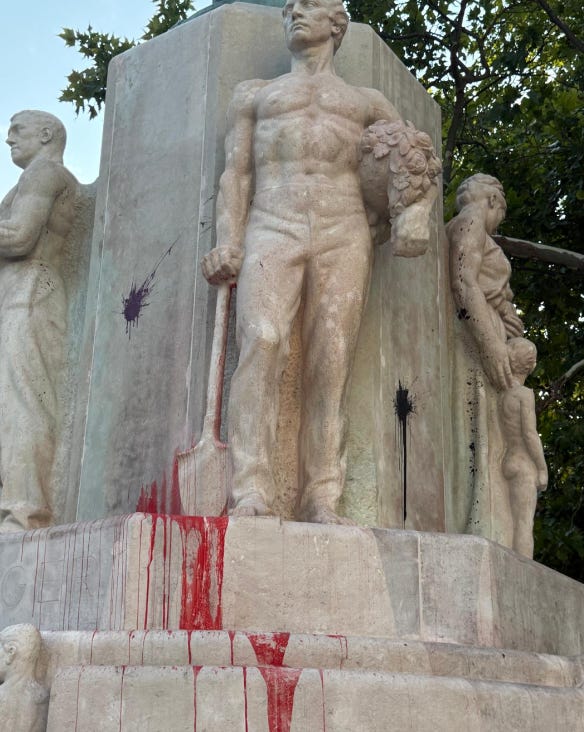
Just outside the café where we met is Lueger Park, a small city square fitted with benches, trees and a large statue of Karl Lueger, Vienna’s controversial mayor from 1897 until his death in 1910. Credited with having modernized the city with significant infrastructure enhancements, Lueger was also a virulent antisemite. While he was mayor, a young Adolf Hitler resided in the city and was inspired by the man. More recently, Lueger’s legacy has been the focus of heated discussion. There has been a degree of popular support for renaming Luegerstrasse, as well as the removal of a statue honoring him in Lueger Park.
Lueger supporters (extreme rightists are a force in Vienna) oppose any changes to Lueger tributes. Leftists of course, champion such initiatives. And then there is the quieter majority. The “undecideds.” They recognize Lueger’s achievements in improving the quality of life for city residents, albeit with a venal touch.
A competition was launched by the Viennese municipal government to reimagine the place of Lueger Park in the city. Local artist Klemens Wihlidal won. The jury felt that his interpretation – to reinstall the Lueger statue at a 3.5-degree angle – imbued the controversy with profundity. Retaining the statue in a compromised form was preferred.
As one Viennese council member put it, “You can’t talk about a blank space.” The idea, of course, is that Lueger remains an important part of Vienna’s past, present and future. Interestingly, the Vienna municipal leadership concluded that Lueger cannot be erased. Or glossed over.
So, the statue of Karl Lueger was cleaned up and re-installed. Earlier this summer the former mayor returned to his place in the park. Atilt but very present.
Target
“It’s because of the flights from Israel.”
When I left Vienna earlier this month, pairs of well-armed, beefy police officers were positioned here and there at the far end of the airport terminal. I noticed a group of four young men leaning against a railing; hanging out at 8 am on a Friday on the departure level of a busy international airport. They had no luggage. Not even a knapsack.
You notice such things after living in Israel for a while.
The police watched the young men, closely. They were dark-haired, dark-skinned and wearing in clothing considered fashionable in certain immigrant communities in Europe.
I mentioned the very visible security presence I had noticed to the check-in agent at the airline counter.
“The helicopters are out and circling the airport too,” she explained.
“The Israel flights arrive and depart in the morning.”
My amateur supposition is that the young men were possibly paid a few hundred euros to observe and report back to handlers what might seem to be mundane information regarding travel patterns of people travelling to and from Israel. Are they easily identifiable? Do they speak Hebrew openly? (Many Israelis have taken to using any language but Hebrew in public when abroad. There have been too many instances in recent months of Israelis. being beaten, threatened and experiencing a range of hostile behaviors.)
It was ironic, leaving Vienna, a city in which Jews are protected by law enforcement, much more so than in my hometown of Toronto, Canada. Austria, of course, immediately conjures a horrific past for Jews. Canada, until recently, has been seen as a welcoming haven.
No longer.
Approximately 250,000 Jews reside in the Toronto area. Violence targeting Canadian Jews has been normalized since October 7, causing many to question how safe they may be there and for how long.
More on that in a podcast coming in the next few days.